The Futures planning scenarios are used by the Regional Transmission Operator to “bookend” a range of potential outcomes and help guide transmission planning for the next twenty years. This latest “refresh” takes into account significant changes to everything from unpredictable federal policy, rapidly shifting tariffs, rising electricity demand from data centers and hyperscalers, problems across supply chains, and more since the MISO Futures were last updated in 2023.
The energy sector has experienced a whiplash of changing circumstances over the last few years, leaving analysts disagreeing on what the future holds for the clean energy transition thanks to an “astonishing” range of possibilities.
The Midcontinent Independent System Operator, commonly known as MISO (pronounced MY-so), is an independent nonprofit organization that manages the transmission infrastructure that facilitates the flow of electricity across 15 states, including most of Louisiana.
Think of it like this: Transmission lines are like highways for power. MISO helps ensure we have enough highways, or transmission lines, to move electricity from where it’s generated to where it’s needed.
There are 7 regional transmission organizations across the country that perform similar functions as MISO. They exist for the express purpose of providing independent and high-level regional grid planning — which utilities in their territories may not otherwise provide.
Like the rest of us, MISO cannot predict the future. It’s impossible to know exactly how the business, technological, environmental, and political conditions in the decades to come will shape our electric system. But using data from utilities, transmission operators, states, industry, and countless other stakeholders, MISO produces “Futures,” or forecasted scenarios for what the future electric system might look like over a twenty-year planning window. These Futures represent possibilities that aim to help stakeholders, like utilities and industrial customers, optimize what resources they choose to build, minimize costs, and ensure reliability and enough resources to meet needs across the region.
In June, MISO released four Futures under the “Futures Series 2” umbrella: three updates to those that were previously released (Future 1, Future 2, and Future 3), and one brand new (Future 4). These scenarios take into account things like:
These Futures are the product of hours of stakeholder engagement workshops, studies, and feedback opportunities. They will be used in the next phase of MISO’s Long Range Transmission Planning, which will focus on both the South and the Midwest.
Louisiana and countless other states in the MISO footprint are in the midst of a historic transition driven by a range of changing economics, increased demand for energy, climate goals, evolving technology, and the affordability crisis. Thanks to accelerated load growth largely driven by the AI and computing boom and a resurgence in domestic manufacturing and electrification, energy demand is rising at a larger and faster pace than the industry anticipated.
At the same time, policy has changed since 2021 and 2023, when MISO dropped Futures Series 1 and Futures Series 1A, respectively. Perhaps the largest change is the passage of President Trump’s Big Beautiful Bill, which repealed and rolled back many of the Inflation Reduction Act’s tax incentives and investments related to clean energy. While more clean energy resources continue to be added to the grid, their market conditions today look very different than they did just a few years ago.
Utilities have already started to respond to the new policy changes and historic load growth and it’s impacting every part of the electric grid — from the buildout of new natural gas facilities to new transmission lines designed solely for Big Tech customers.
With so much anticipated growth in electricity demand and new generating capacity coming online, it’s critical to ensure that generating facilities and power lines are built affordably and with residential ratepayers in mind.
While the Futures reflect the new resources that will be needed over the twenty year planning horizon, these resources will continue to shape the grid and residents’ utility bills for decades after. At The Alliance, we want to ensure that plans for the future have Louisianans’ best interest at their core, not just new large load customers like data centers.
As we mentioned, there are four Series 2 Futures. Futures 1, 2, and 3 have been updated with new assumptions for load growth (new energy demand), but Future 4 is brand new. MISO says the key elements shaping the entire series are an updated load forecast and comprehensive resource adequacy assessments, which help ensure the system has enough power to keep it going. The biggest changes by far are the new demand forecasts, which span slower load growth (Future 1) to faster load growth (Future 3). Utilities’ plans and the degree to which they were achieved, emissions, and generation retirements did not change from Series 1 and 1A.
Future 4, on the other hand, goes beyond load growth. Its growth assumptions mirror Future 2’s growth rate of 1.6%, but incorporate additional Demand Response – i.e. voluntary changes to how the customer consumes energy to better meet immediate demand – if needed. The predicted emissions reduction is also the same as Future 2 at a 60% reduction from 2005 levels. However, MISO adds that could change if supply chain problems like labor shortages, economic changes, and construction and grid connection delays stop limiting how fast infrastructure can get online. Footprint development, or the landscape of energy providers’ energy facilities, is reflective of this supply chain friction. In this case, the “supply friction” affecting the build rate interferes with the timelines behind MISO members’ plans and goals. Finally, unlike the other Futures, Future 4 sees no generating facility “retirements,” or closures, based on the age of the facilities. That means no coal plant retirements like many members had planned.
Again, these Futures are only scenarios, or modeled possibilities based on different conditions. However, should these Futures come to pass, MISO has predicted significant changes to the capacity mix, i.e. the combination of resources that make up how much energy the entire system can generate. Finally, while not many assumptions have changed in most Futures outside of load growth, these scenarios still incorporate the changing market conditions driven by the loss of Inflation Reduction Act.
What is the effect of these changes on the system? These two charts spell it out.
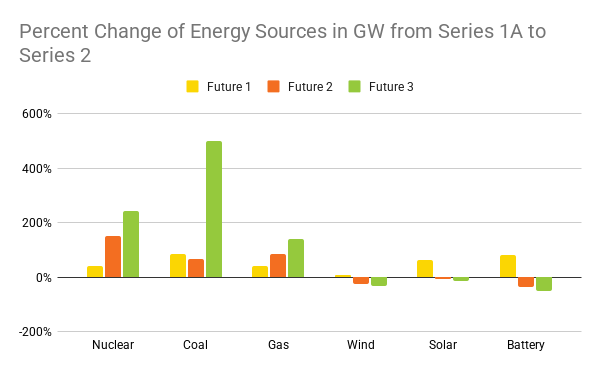
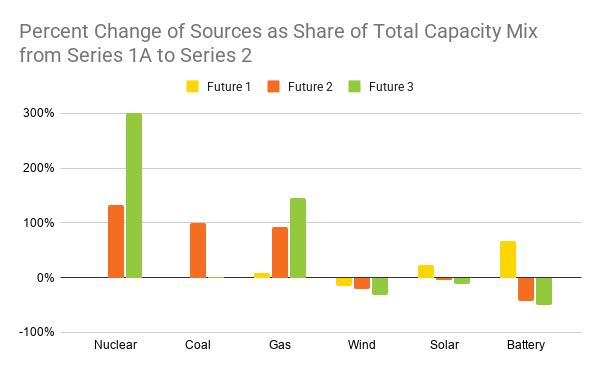
The one on the left shows the percent changes to each source’s capacity in GW from Series 1A Futures to Series 2 Futures. That is, how much each type of energy source grew or shrank in capacity from Series 1A (2023) to the new Series 2 (2026). The one on the right shows the percent changes to each source’s share of the total modeled capacity mix from Series 1A Futures to Series 2 Futures. It’s worth noting the Series 1A project Futures to the year 2042, while Series 2 projects them to the year 2045, so the additional three years of development could be affecting these percent changes, too.
As you can see, wind capacity has declined across the board. Solar and battery storage are also a smaller percentage of the mix in several of the scenarios. However, in every scenario, natural gas is modeled to make up roughly one-quarter of the system. Nuclear and coal also enjoy a predicted boost in some of the Futures, while in Series 1A, they were almost entirely discussed in terms of retirements. Small modular nuclear reactors (SMRs) play a significant role in this predicted rise.
These changing predictions come despite a MISO member survey demonstrating more planned wind and solar. MISO notes that in addition to the reduction in IRA-era tax credit incentives, renewable development may be constrained by some domestic reliance on foreign supply chains and demand exceeding manufacturing capacity. MISO also highlighted the uncertainty affecting the solar industry thanks to changing tariffs on key construction and manufacturing materials.
These models predict a very different future for Louisiana than had previously been modeled. Because of the scale of new demand, MISO predicts there will be more natural gas plants than we have now. Unlike renewables and other alternatives, natural gas plants compromise our air quality and cost residents more. MISO also foresees a real chance that states in its footprint will not close highly polluting facilities like coal plants, which threaten the health and wellbeing of families across the state.
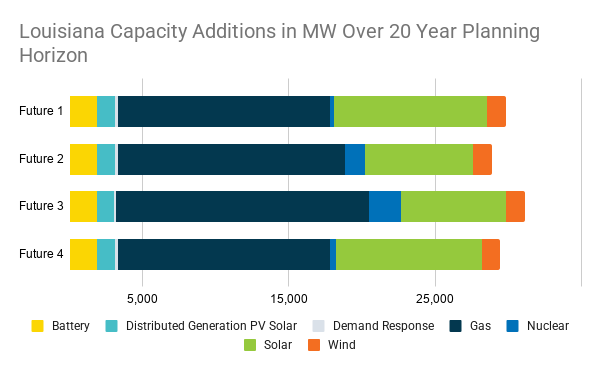
With fewer renewables predicted to be built over the next 20 years – 76% less wind and an average 36% less solar – Louisiana is predicted to be more reliant on dirty fuels.
The differences between these new Futures and the previous Series 1 and Series 1A Futures also show how unpredictable policy and fluctuating tariffs cause meaningful uncertainty that affects what gets built and when. Without greater certainty about future economic conditions, it is renewables that suffer the most.
Which of these Futures most closely resembles future realities remains to be seen. In the meantime, The Alliance will continue to fight for reliable, resilient, and affordable energy solutions.