The report, produced in partnership with Empower LLC, examines five “hyperscale” data center projects currently under development: Meta’s proposed Hyperion facility in Richland Parish, three Amazon data centers in northwest Louisiana, and Hut 8’s AI infrastructure project in West Feliciana Parish.
Researchers found that just two of those projects—Meta’s Hyperion campus and Hut 8’s planned facility—could require up to 7.2 gigawatts of electricity, roughly equivalent to the annual power use of 5.7 million homes.
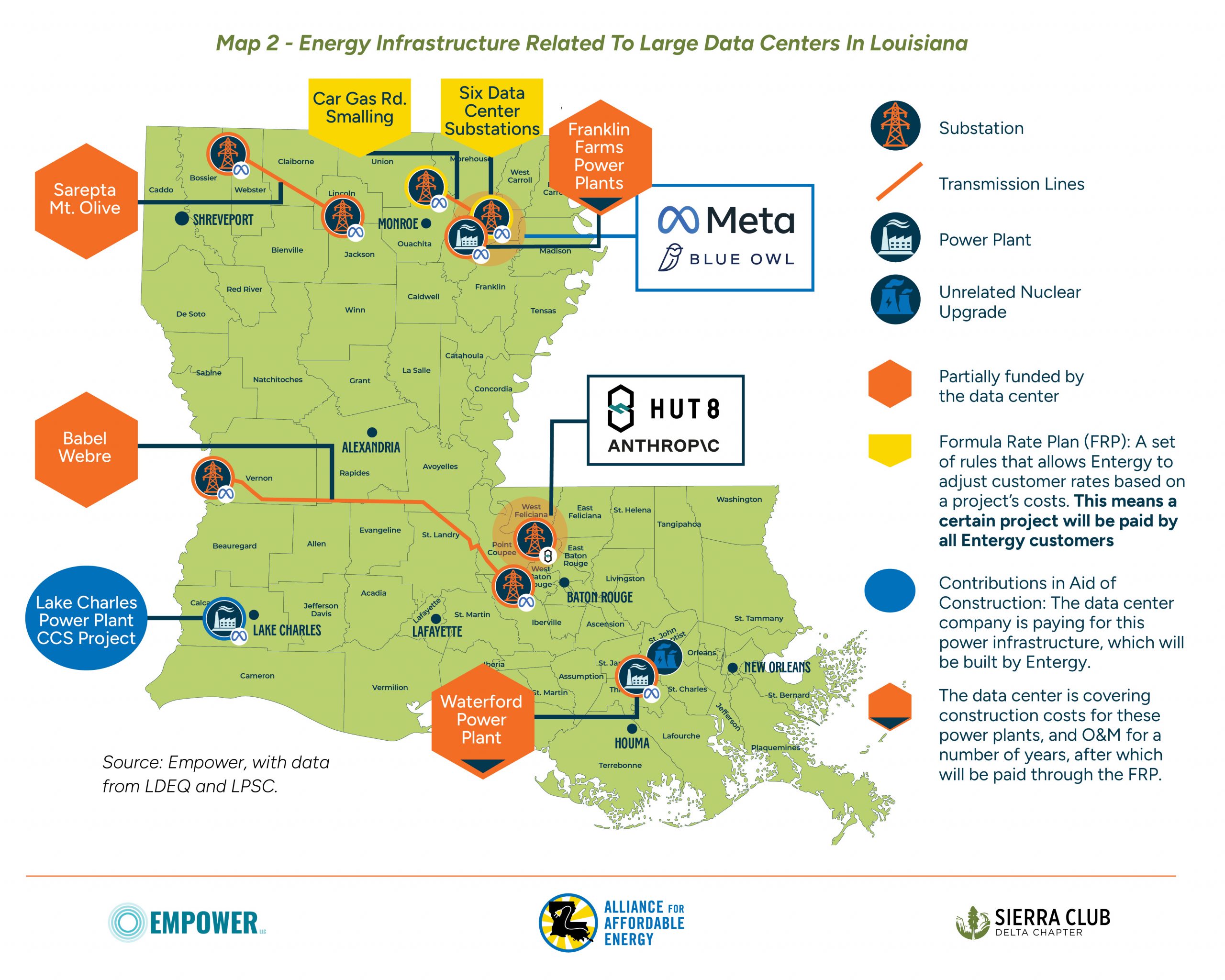
The report also raises concerns about opaque financing structures, undisclosed utility agreements, and Louisiana Public Service Commission (LPSC) rules that could shift major infrastructure costs onto residential ratepayers.
“This research shows that Meta can walk away from billions of dollars of investments in 2033, leaving Louisiana families to pay for this new infrastructure for decades,” said AAE Executive Director Logan Burke. “We deserve to know the real stakes of these projects.”
Among key findings of the report:
The report also details how large private investment firms, including Blue Owl Capital, have become central players in financing Louisiana’s data center expansion through private-market transactions that are subject to limited public scrutiny. The $27 billion bond backing Meta’s Hyperion project received a rating from only one agency (S&P Global) and is held by major financial institutions including PIMCO, BlackRock, and Prudential.
“The scale of power demand associated with the Meta project is staggering,” said Dennis Wamsted, Energy Analyst at the Institute for Energy Economics and Financial Analysis. “Unfortunately we are seeing rapid growth with little thought to what it means for consumers across the country. The reality is, utilities should be skeptical of projects that overlook ready-to-deploy, reliable, and affordable energy sources like solar, wind, and battery storage.”
“Even as new details about these massive data centers come to light, our public officials refuse to acknowledge the real concerns and resistance from people on the ground,”says Angelle Bradford Rosenberg, Chair, Sierra Club Delta Chapter. “Communities are just not given adequate time to address the financial risks, let alone the other knock-on impacts.”
Community advocates say residents have repeatedly sought more information about the projects and their impact, only to encounter confidentiality claims and limited disclosure.
“We’ve asked for information again and again but have been turned away by our elected officials and appointed regulators,” said Mary Stahl May, Caddo Parish resident. “We deserve to know the details of these deals and to have a say in our own utilities and public costs.”