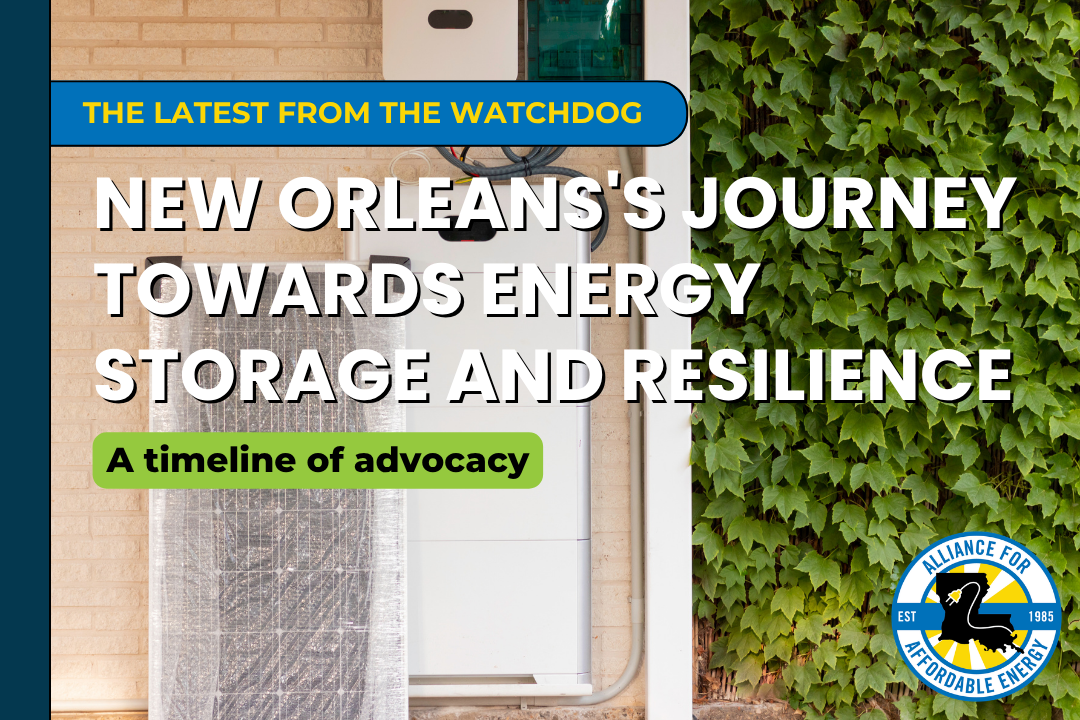
In September, the New Orleans City Council approved a $29 million program that will incentivize households and businesses to acquire battery storage. Each installed battery works together as a part of a Virtual Power Plant (VPP) in a network of distributed energy resources (DERs) that can be coordinated to relieve strain on the electric grid when power is needed most.
Unlike a traditional power plant, a VPP is not a large building producing electricity in one location. Think of it as a neighborhood potluck. One person may not have enough food to feed everyone, but when more guests bring something to the table, suddenly there is plenty to go around.
When the larger electric grid goes down during a hurricane or another emergency, a battery – ideally paired with solar – can provide backup electricity at the place where it is installed. That could mean keeping lights on at a home, refrigeration running at a neighborhood business or essential equipment operating at a community facility.
At other times, the grid could be under strain due to high energy demand or less power being generated. That could be caused by a hot day when everyone is blasting their air conditioning at the same time or when a power plant goes offline. This can induce a load shedding event, a last-resort controlled power outage ordered by grid operators in order to prevent larger, uncontrolled blackouts. Batteries coordinated through a VPP can provide power to a number of homes in these moments, meaningfully reducing demand on the power grid and preventing more homes from going offline. The more batteries activated at once, the more strain is alleviated from the grid.
The New Orleans City Council has allocated $23 million in up-front incentives for residents and businesses to purchase roughly 800 batteries for homes and more than 200 businesses. Forty percent of the residential upfront incentive funding has been earmarked for low and moderate-income customers (LMI). The Alliance for Affordable Energy has argued that those households should not have to come up with substantial money upfront to participate. Thankfully, the council is providing those households with an $850 incentive, which, when combined with available tax incentives, effectively eliminates their up-front costs.
AAE has been advocating for expanded battery storage for a decade. Thanks to the advocacy of people like you, this program will come at no additional costs to residents. Instead, CNO is committing $29 million in settlement funds.
For residents, the most important thing is to stay informed and involved as the City Council gets closer to approving a final implementation plan. Commit your community to the conversation by following docket UD-24-02, attending public meetings, submitting comments and asking questions about household resilience and access for lower-income families.
Instead of relying only on electricity produced far away and delivered across miles of wires, New Orleans can seize the chance to build part of its energy system in its neighborhoods one home at a time, increasing resident agency and security. A VPP may sound like a highly technical idea, but its spirit is about who gets access to reliable energy, who benefits from public investment and how communities prepare for the next major outage. The decisions made now could shape how New Orleans powers and protect its communities for years to come.