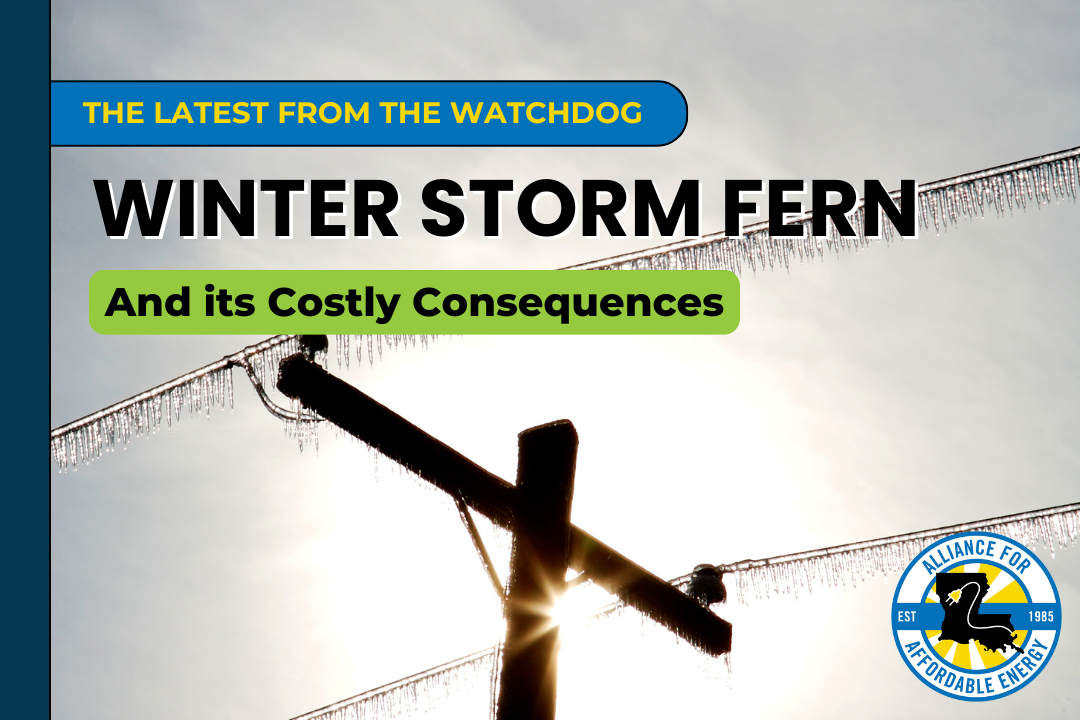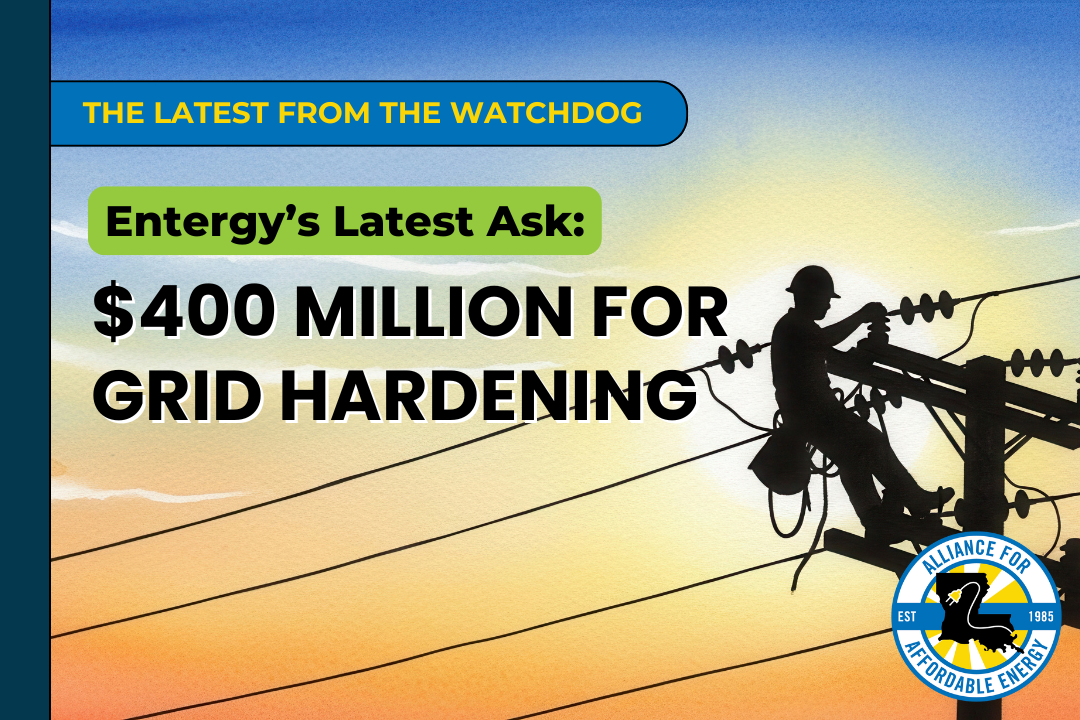
This is phase 2 of what Entergy is calling its “Resilience Plan.” You may recall that after Hurricane Ida in 2021 the Council directed Entergy to develop a plan to strengthen the electric grid and improve resilience in the face of increasingly frequent and intense and extreme weather and outages.
About a year later Entergy New Orleans submitted its 10-year $1 billion “Resilience Plan.” Phase 1 of that plan, which included $100 million in grid hardening investments, was approved by the Council in 2024. Now Entergy is asking to begin Phase 2, and their proposal is under review by the New Orleans City Council.
At a high level, The Alliance agrees on one core point: New Orleans needs a stronger, more reliable electric grid. Climate change is making storms more intense and more costly, and the status quo is failing too many residents.
But what projects we prioritize, how we pay for grid hardening, and who bears the cost, matters just as much as whether these investments happen at all.
New Orleans is one of the cities most vulnerable to the effects of climate change. In just the last few years, residents have endured Winter Storm Uri, Hurricanes Laura, Delta, Zeta, Ida, Beryl and Francine, and repeated extreme heat events. Each disaster has exposed weaknesses in our electric grid and left residents paying heavily: first through prolonged outages, and again through storm repair charges on their utility bills.
In 2020 alone, New Orleans was impacted by three hurricanes resulting in an estimated $38.5 million in damage. And in 2021 Hurricane Ida caused over $120 million in damage and resulted in 26 people losing their lives. Virtually all of the loss of life in our community following Hurricane Ida was related in one way or another to a lack of power – either because of inability to regulate extreme heat or because of exposure to fumes from fossil fuel generators.
Stronger poles, hardened lines, and smarter system design can reduce outages and lower long-term storm costs. These investments are necessary, and AAE has consistently supported meaningful, well-designed grid hardening that delivers real benefits to the community, especially to those most vulnerable.
But the fact of the matter is that New Orleanians have been asked to pay higher utility bills for poorer services for many years, to the point where electricity is unaffordable for many households. New Orleans residents must not be made to bear the full cost of resilience and storm hardening measures that Entergy should have undertaken years ago.
A prudent utility would have begun the process of hardening its grid and transitioning to local, renewable energy after Hurricane Katrina in 2005. But instead Entergy deliberately delayed necessary maintenance of its infrastructure in order to pay out dividends to shareholders. The extraordinary costs ratepayers have had to cover following major storms would almost certainly be lower if Entergy had properly maintained its system with the dollars the utility recovers from customers for operations and maintenance, rather than shifting some of those funds to the company’s profit line.
When disaster strikes and the electric grid fails, it is the most vulnerable among us who pay the ultimate cost. We must move swiftly, but deliberately, in order to create a livable city for all New Orleans residents.
In the wake of Hurricane Ida in October of 2021 the New Orleans City Council opened docket UD-21-03 to require Entergy to strengthen our electric grid and reduce weather and storm-related outages. In the initiating resolution, the Council acknowledged that “this cycle of damage and repair is not sustainable for the Company or ratepayers.” In April of 2023 Entergy submitted its initial storm hardening application, a 10-year plan with a price tag of $1.5 Billion.
The Alliance intervened in that proceeding and submitted multiple rounds of comments and testimony pushing for:
We also encouraged the Council to use its broad authority to implement other measures to protect ratepayers from excessive costs, including:
In February 2024, after multiple rounds of comments, questions, and expert testimony, the Council partially approved Phase 1 of Entergy’s plan, including $100 million in grid hardening investments that will take place from 2025-2026. That includes 65 projects, strengthening more than 3,000 structures and upgrading 63 miles of electric lines.
These projects all had broad stakeholder consensus and support. Importantly, Phase 1 was approved without immediate bill impacts because the Council used settlement funds (from the Grand Gulf/SERI settlement) and a DOE grant.
Phase 2 is where the stakes rise. At a time when bills are already high, it is critical that every dollar invested delivers real, measurable benefits for the people of New Orleans.
The Alliance is participating in the proceedings in docket UD-21-03 to ensure Entergy is prioritizing investments that bring the greatest benefits to ratepayers and the community and that the costs of such investments are not unfairly placed on residents.
As the City Council reviews Entergy’s Phase 2 application, we will continue to submit recommendations and advocate for a resilience plan and electric grid that puts people first. We’ll keep residents informed as this process moves forward and share updates as we review the application and file comments on what should, and should not, be approved.