The hot topics were SLECA’s abandonment of South Louisiana communities in Terrebonne and Lafourche Parishes, Entergy’s Formula Rate Plan (FRP), a lawsuit brought by a coalition of Landowners against the LPSC, and the stipulated sale of Cleco to a new private equity-backed holding company.
Click the following links to read the agenda and supplemental agenda the November LPSC meeting was about.
Commissioners deferred a new rule allowing large load customers to create Private Electrical Networks (PENs). This means the rule has been postponed until a later time.
PENs would allow new large loads to buy, own, and operate their own electrical system (including generation, transmission, and distribution) to service their facilities on contiguous property, or nearby property connected with approved transmission.
The original goal of the PEN docket was to address the rapid expansion of large loads in the state and their electricity demands, while also being positioned as an opportunity for industrials to buy and build more renewable energy.
The latest version of the rule splits the baby between what the industrials want and what the utilities want, to the point that it might make the rule a nothingburger. Additionally, the rule makes it nearly impossible for renewable energy to be developed.Renewable energy is one of the reasons The Alliance for Affordable Energy originally might have supported a rule allowing networks of this kind, but the latest version of this rule likely makes it unworkable. Another opportunity AAE sees with PENs would be for industrial customers to mitigate the need for utilities to build new expensive plants to serve growing industry, but that would be paid for by all customers including residents.
Industrials can already build behind the meter generation. This PEN rule adds red tape, requiring PENs to go through a formal consideration process before the Commission and subjecting approved PENs to ongoing reporting and oversight. Industrial groups have sent letters to the Commission to request another opportunity to change the rule before a vote.
The LPSC denied SLECA’s motion for rehearing to allow the electric utility provider to abandon their customers in South Louisiana.
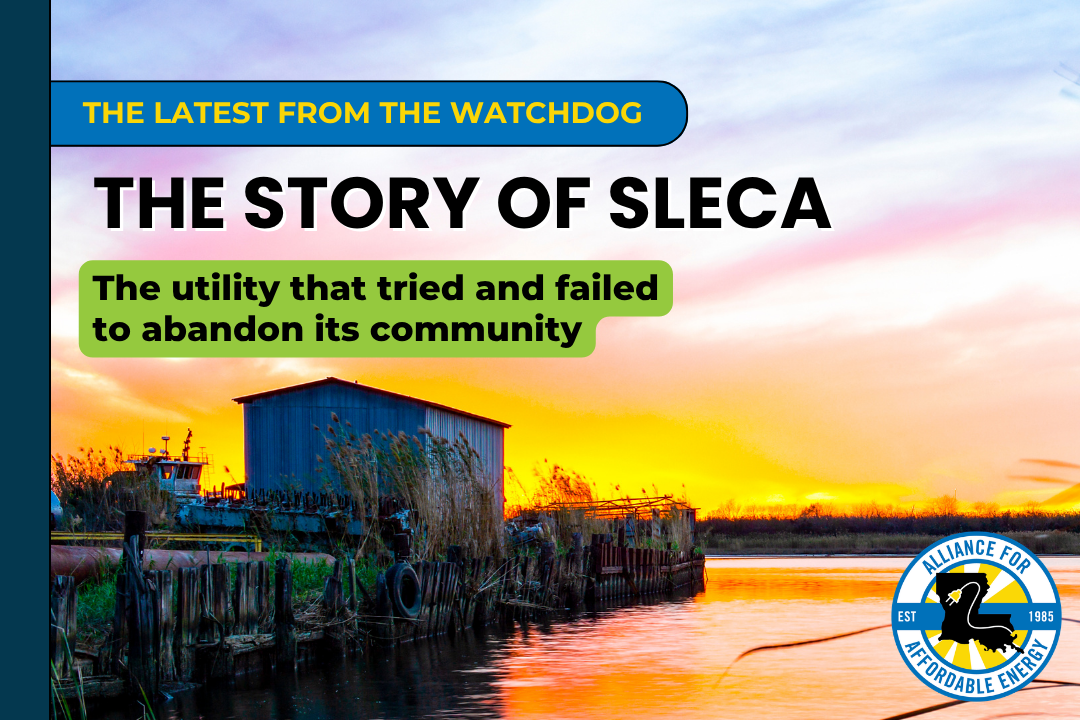
The motion relates to South Louisiana Electric Cooperative Association’s abandonment of service to nearly three hundred households who have been without power since Hurricane Ida hit in 2021.
Following the storm, three badly damaged segments of the “Lake Line” were never repaired, leaving residents in Lake Fields Island, Lake DeCade, and Grand Pass without electric service. Despite promises that the line would be rebuilt, SLECA ultimately asked the Commission to allow them to abandon service, arguing the cost of restoration was too high.
In February, an Administrative Law Judge (ALJ) found that SLECA failed to meet their burden of proof of explaining why total abandonment is in the public interest, and also failed to identify affordable alternatives to restoring power or financing as is required by PSC rules.
During September’s PSC meeting, Commissioners brought relief to many of those families who feared service would never be restored when they rejected the utility’s request to permanently abandon electrical service. While SLECA was allowed to abandon service to residents on the DeCade line, residents on other lines were assured SLECA could not abandon them, too.
At last month’s Commission meeting, SLECA was called to share an update on the status of service restoration to the residents in Lake Fields and Grand Pass. The Commission asked SLECA to share an update because they did not want residents to wait any longer than they already have for progress towards restoration. However, the status update was brief and offered no clarity around what SLECA is actually doing to bring homes back online.
At the same time, SLECA asked the PSC to reconsider their September decision by rehearing the matter. That decision was deferred to this month, when the Commission rejected SLECA’s motion for rehearing. The decision highlights the Commission’s commitment to ensuring all ratepaying residents maintain fair access to utilities.
SLECA is still fighting against the order to restore service. In Exhibit 5, SLECA sought to have the Commission consider a rehearing on the utility provider’s request to abandon service. However, the exhibit was denied.
Representatives of SLECA refused to acknowledge resident camps as homes, where they live daily lives. Resident and advocate Sara Boudreaux asks, “the commission to require SLECA to establish the documented cost to restore each remaining segment.”
AAE urges the PSC to push SLECA to explore other alternatives like solar + storage, which could restore power without the high cost of rebuilding and maintaining the line. We will continue to encourage resident involvement in the decision-making process.
The uncertainty and chaos residents are still enduring demonstrates why the Commission must work to establish protections for Louisianans so that no utility can treat their ratepayers like SLECA did. Specifically, rules are needed to define whether and how utilities are required to notify customers and seek the approval of the PSC about their intent to abandon electrical service. Without these rules, many more Louisiana residents could face arbitrary disconnections and SLECA ratepayers could be left in financial disrepair.
The Commission denied Norris’s petition for declaratory order and moratorium on Magnolia Water’s frequent billing and water quality issues. A moratorium is a temporary hold and a declaratory order essentially defines a rule.
Connie Norris, a resident served by Magnolia Water, has been raising serious concerns about her water provider’s billing increases before the Commission. Norris called for the Commissioners to declare a stance on behalf of residents in her community. Ultimately, the LPSC decided to uphold the Administrative Law Judge’s (ALJ) recommendation to deny Norris’s petition to pause billing increases and draw a line in the sand.
Commissioners stepped behind closed doors into an Executive Session to discuss their litigation strategy to the Louisiana Landowners’ Coalition Lawsuit against the PSC. This case strikes at the heart of the Lightning Directive, which gives utility companies that want to serve data centers the ability to bypass procedural steps that protects ratepayers from paying costs on projects before they are approved by the Commission. The Louisiana Landowners’ Coalition, Save My Louisiana Inc., and Louisiana Citizen Advocacy Group are banding together to make the case that not only is it illegal for the LPSC to approve issues using the Lightning Directive, but also unconstitutional.
Proceedings are currently under way at the 19th Judicial District Court, and if the presiding judge rules in favor of the LPSC, some landowners will be forced to sell their land through eminent domain to serve Meta.
Formula Rate Plans (FRP) are multi-year plans that allow a utility to have rate adjustments on an annual basis outside of a general rate case, as needed. Some FRPs set a plan for incremental increases over time to manage rate spikes if there are significant increases needed.
Entergy requested and secured a one year extension on their existing FRP, which will mean the utility won’t file for another rate proceeding for another year, which pushes a new rate structure out two years. The utility argued the additional year extension would reduce costs and administrative burden at the commission.
Something else to know: Entergy has been receiving FRP extensions for more than a decade, typically three years at a time. They have not re-set rates based on the cost of service to different kinds of customers, and we expect that after this one year extension ends, the significant expansion in industrial energy sales will mean significant shifts in Entergy’s rate structure.
Commissioner Lewis indicated he wanted to condition approval of this one year extension on an independent management audit of Entergy Louisiana. Management audits have been successful in other states to find significant cost savings and efficiencies that can be passed on to their customers. Unfortunately Entergy got their extension without that audit, and CM Lewis voted in opposition.
The LPSC approved Entergy’s settlement with staff to uprate the Waterford 3 nuclear facility by 45MW. This modification will run the reactor at higher capacity and increase output of energy instead of building a brand new power plant. While it has been floated that Meta would foot the bill for the $68M price tag, that remains to be confirmed in another proceeding. Nuclear power in Louisiana has come with expensive cost over-runs; and following a prior uprate at Grand Gulf in Mississippi, that plant’s performance actually decreased costing customers many millions of dollars.
The Commission and Entergy say that this uprate will be a “net benefit” due to the improved efficiency and additional available capacity. We will be watching closely to see if those benefits show up. We’ll know soon, as Entergy noted they’ve already been working on the uprate and they expect the plant to be up and running “soon.” As always, who pays for these things matters, and we want to ensure that any new costs don’t get passed to residents.