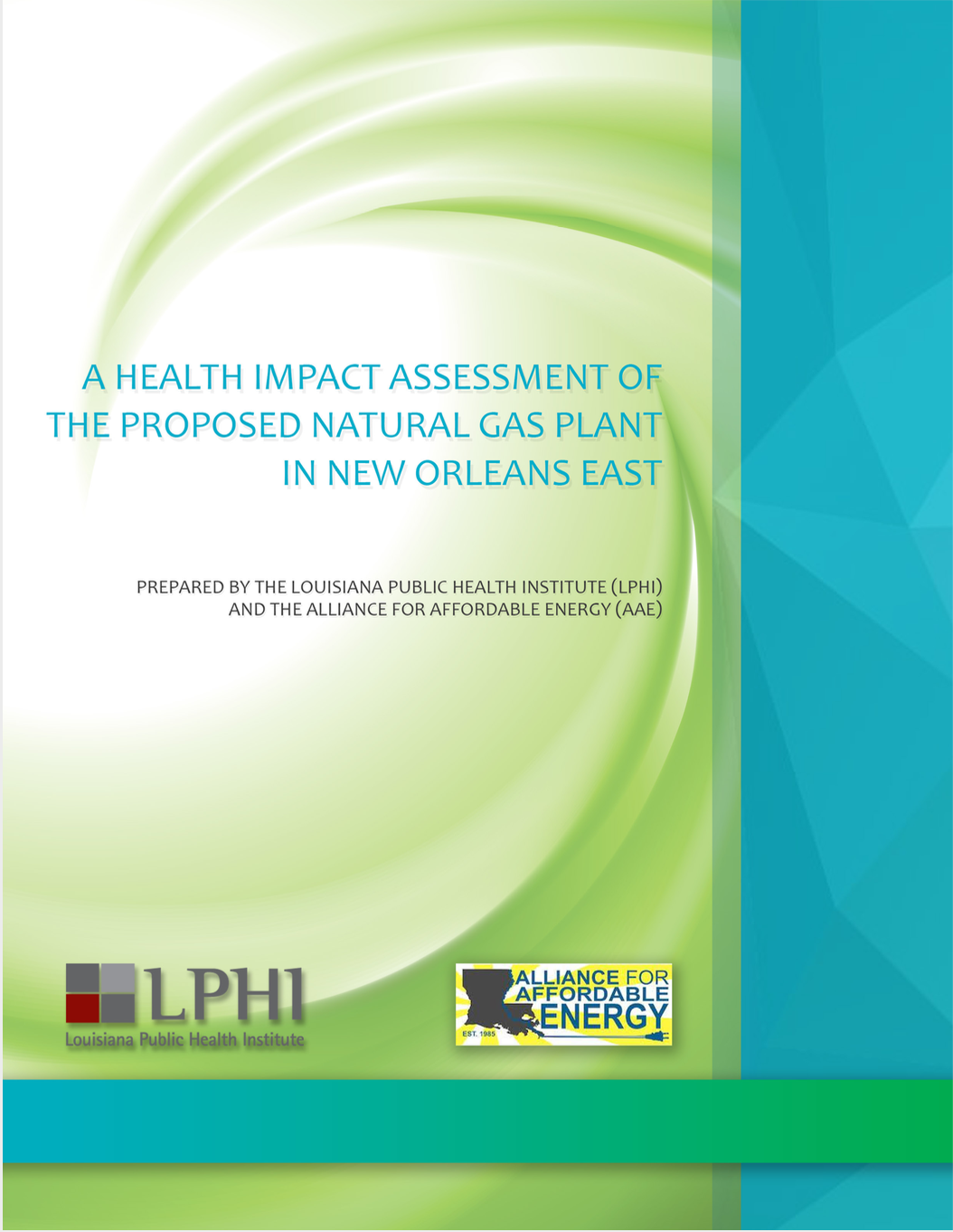
This HIA, with input from the New Orleans City Council, Entergy New Orleans (ENO) as well as community stakeholders from New Orleans East, endeavors to bring concrete health costs to the energy decision-making process. While this HIA does not attach dollar values to the health outcomes discussed, it does allow real public health issues to be included in the conversation and final decision-making about new energy resources for the city.
Entergy has proposed to build a new natural gas combustion turbine (CT) plant in New Orleans East on the same site as the former Michoud Power Plant, where the former Entergy-operated unit was decommissioned on June 1st, 2016. According to Entergy’s proposal, the CT plant would fill a gap in local energy services, principally during the hot summer months when energy demand is at its highest. As the regulatory body, the New Orleans City Council will ultimately decide how to replace the power generated by these plants.
“The New Orleans East community is very concerned about this planned project due to no prior community involvement from Entergy and if built, the damaging effects imposed on its residents and the soil,” said Dawn Hebert, an New Orleans resident.
The HIA sought to determine the potential health impacts of the proposed CT plant in order to help the City Council make a more informed decision. Secondarily, the HIA aimed to formulate recommendations on how to maximize benefits and minimize harms of the proposed CT plant. Third, the HIA intended to study and quantify health data and costs and create a model for how the City Council may capture health costs into the triennial resource planning process, called the Integrated Resource Plan, in order to properly account for ongoing externalized costs related to energy generation.
“Historically, the cost of producing energy had a financial cost and a health cost,” said Casey DeMoss, CEO of the Alliance for Affordable Energy. “The health costs were unfairly born by the lives of African American communities. In the 21st-century, we no longer have to choose between safe energy and affordable energy.”
“It is critical that City Council consider the health impacts of the proposed CT plant, both immediate and long term,” said Lisanne Brown, LPHI’s Director of Evaluation and Research. “The immediate risk of subsidence due to groundwater use could increase the risk of flooding, accidents and result in displacement of residents. Long term health impacts could include increased risk of respiratory illness and asthma, and cardiovascular disease.”
This project was supported by a grant from the Health Impact Project, a collaboration of the Robert Wood Johnson Foundation and The Pew Charitable Trusts. The views expressed are those of the authors and do not necessarily reflect the views of the Health Impact Project, the Robert Wood Johnson Foundation or The Pew Charitable Trusts.
Louisiana Public Health Institute and the Alliance for Affordable Energy held an HIA training session, inviting decision makers and community members to learn about the HIA process.
Resources:
Founded in 1997, The Louisiana Public Health Institute’s mission is to promote and improve the health and quality of life in Louisiana through public-private partnering at the community, parish and state levels. By fostering collaborative endeavors in the areas of health information, public policy, applied research, and community capacity enhancement, LPHI works to develop community-oriented solutions that improve the health of the Louisiana population. For more information, visit lphi.org.